

Hurry Up | Admissions Going on – March & September Intake,2026

Hurry Up | Admission Going on – March & September Intake,2026

Hurry Up | Admissions Going on – March & September Intake,2026

Hurry Up | Admission Going on – March & September Intake,2026

02:54:37

+86-13505426660
admission@futureconsultingedu.com
Apply Now

Why China

The Key to Your Bright Future in China

Discover China

As a country in East Asia, China is located on the west coast of the Pacific Ocean. Its land space is 9.6 million square kilometers and maritime area is 4.7 million square 

kilometers. The length of China’s eastern and southern continental coastlines surpasses 18,000 kilometers. There are more than 7,600 islands on the sea, of which Taiwan Island is the largest, with an area of 35,798 square kilometers. China shares a border with 14 countries in land and eight countries by sea. There are 4 municipalities, 23 provinces, 5 autonomous regions, 2 special administrative regions. Its capital is Beijing.


National Symbols 

Legally defined symbols of national sovereignty and dignity.

National Flag: Five-star Red Flag – Red for revolution; one large star for the Communist Party of China, four small stars for the great unity of the Chinese people.

National Anthem: March of the Volunteers – Written in 1935, a tribute to the nation’s indomitable spirit; stand solemn when it is played on formal occasions.

National Emblem: Tiananmen Gate under five stars, flanked by grain and gear – Symbols of national spirit, worker-peasant alliance and people’s unity.

National Day: October 1st – 7-day holiday to celebrate the founding of the PRC in 1949.


Languages

Official Language: Mandarin Chinese (Putonghua) – Used nationwide in education, media and official affairs.

Dialects & Minority Languages: Various dialects (Cantonese, Shanghainese, Sichuanese,etc.) and minority languages are spoken across regions.


Capital

Beijing – China’s political, cultural and international exchange hub.

• A historic city home to world heritage sites likethe Great Wall and the Forbidden City.


Population and Ethnicity

Total Population: Over 1.4 billion, the world’s most populous country.

56 Ethnic Groups: Han people as the majority; 55 ethnic minorities with unique cultures and customs.


Climate

China has a diverse climate shaped by its vast territory, spanning multiple latitudes and complex terrains from tropical zones to frigid plateaus.

Northern China features a temperate continental climate, with cold, dry winters and warm, rainy summers. Temperature differences between seasons are distinct, and 

   snow is common in winter.

Eastern and Central China have a subtropical monsoon climate, characterized by hot, humid summers and mild, dry winters. Rainfall is abundant, mainly concentrated 

   in the summer months.

Southern China lies in the tropical monsoon climate zone, where temperatures stay high year-round with plenty of rainfall. It has no distinct winter and is suitable for 

    tropical plants to grow.

Western China, including the Qinghai-Tibet Plateau, has a plateau climate. It is cold with large temperature differences between day and night, thin air, and strong solar radiation.


Public Holidays

China has a mix of statutory public holidays that combine traditional cultural festivals and modern national celebrations, most of which come with paid time off for workers 

and students. Here are the major ones you should know:

1. New Year's Day

Observed on January 1st each year, it marks the start of the Gregorian calendar. Usually a 1-day public holiday, it’s a low-key celebration with small gatherings or short trips.

2. Spring Festival (Chinese Lunar New Year)

The most important and widely celebrated festival in China, falling on the first day of the lunar calendar (usually late January to mid-February). It has a 7-day holiday, known 

as the "Spring Festival Golden Week". Key traditions include family reunions, eating dumplings or rice cakes, giving red envelopes (hongbao) with money, and watching the 

Spring Festival Gala. Many cities also hold dragon and lion dances to celebrate.

3. Qingming Festival

Also called Tomb-Sweeping Day, it usually falls in early April (April 4th or 5th). A 1–3 day holiday, it’s a time for people to honor ancestors by cleaning their tombs, offering 

sacrifices, and enjoying spring outings as the weather turns warm.

4. Labor Day

Celebrated on May 1st, it’s a tribute to workers. The holiday typically lasts 5 days (May Day Golden Week), making it a popular time for domestic travel and family getaways.

5. Dragon Boat Festival

Falling on the 5th day of the 5th lunar month (usually June), it has a 1–3 day holiday. It commemorates the ancient patriotic poet Qu Yuan. Traditional activities include dragon 

boat races, eating zongzi (glutinous rice dumplings wrapped in bamboo leaves), and hanging mugwort to ward off evil.

6. Mid-Autumn Festival

Observed on the 15th day of the 8th lunar month (usually September or October), it’s a 3-day holiday centered on family reunion. The festival is associated with moon-viewing, eating mooncakes(round pastries with various fillings), and sharing stories about the moon goddess Chang’e.

7. National Day

Celebrated on October 1st to mark the founding of the People's Republic of China in 1949. It has a 7-day holiday (National Day Golden Week), when people travel across the 

country, attend national flag-raising ceremonies, and join festive events held in major cities like Beijing.
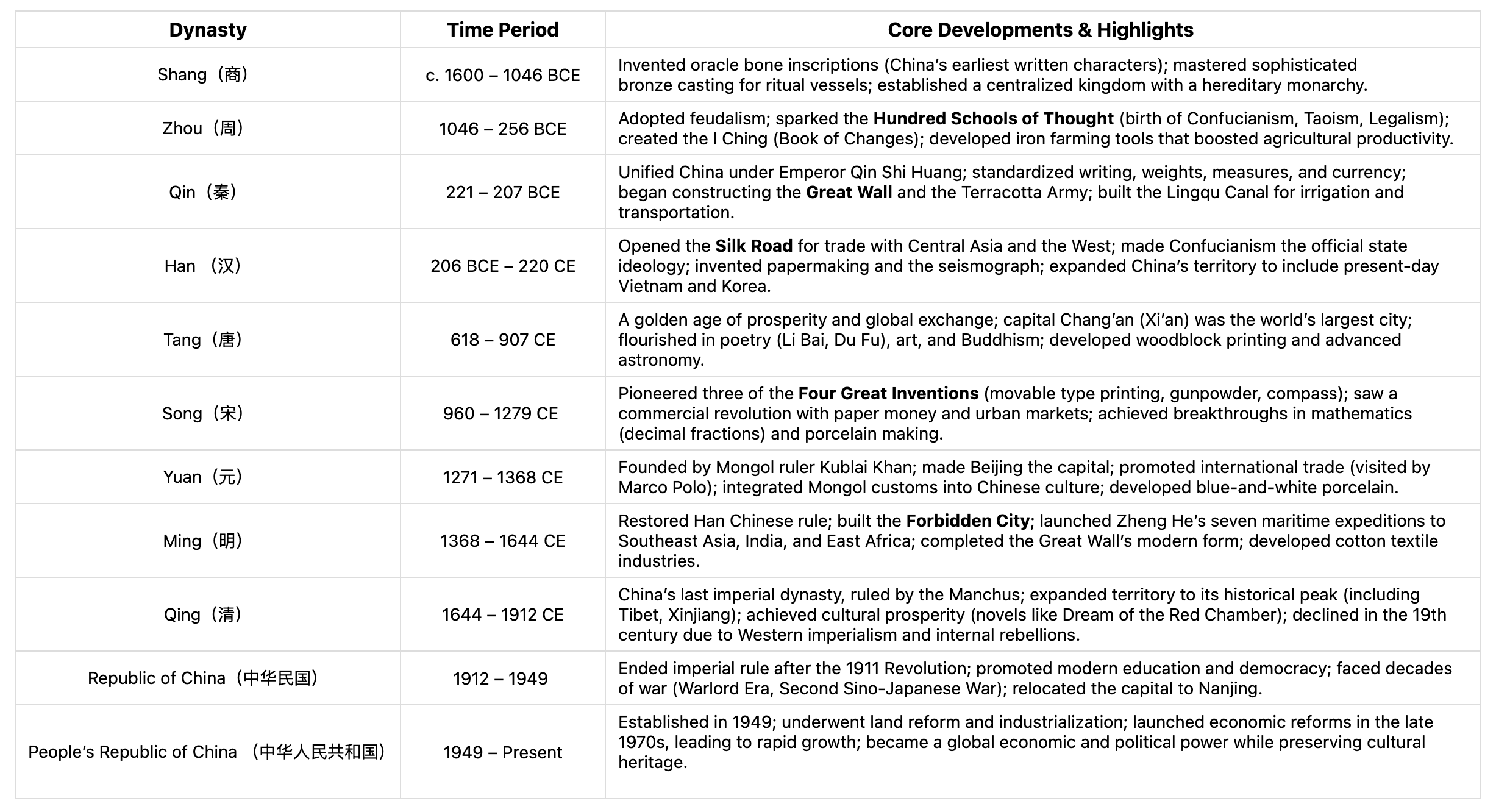
China has one of the world’s oldest continuous civilizations, with a history spanning over 5,000 years. Its development is marked by a series of dynasties, each contributing unique political systems, cultural chievements, and technological innovations. The following table outlines major dynasties and their key highlights:


WechatIMG1677.jpg


Core Takeaways

• Chinese civilization originated along the Yellow and Yangtze Rivers, with early farming cultures laying the foundation for dynastic rule.

• The Silk Road (opened during the Han Dynasty) and maritime voyages (Ming Dynasty) facilitated cultural and economic exchange between China and the rest of the world.

• Four Great Inventions (paper-making, printing, gunpowder, compass) from ancient China had a profound impact on global civilization.

Top Traditional Chinese Culture Experience List for International Students


1. Learn Peking Opera Makeup & Poses

Join a 2-hour workshop to try hand-painting iconic Peking Opera facial patterns (e.g., red for loyalty, black for integrity) and learn basic stage poses with a professional actor. 

No prior experience needed.

2. Practice Chinese Calligraphy with a Master

Use a brush and ink to write your name in Chinese characters or classic poems. The master will teach you how to hold the brush correctly and control ink flow for elegant strokes. 

Take your work home as a souvenir.

3. Try Paper Cutting Art

Follow a folk artist to cut auspicious patterns (like pandas, flowers, or Chinese knots) from red paper with scissors or a small knife. Your finished paper cuttings can be used as 

window decorations for festivals.

4. Make Your Own Porcelain Cup

Visit a pottery studio (e.g., in Jingdezhen or local craft spaces) to shape clay into a small cup on a pottery wheel. You can paint patterns on it and pick it up after it’s fired a few 

days later.

5. Weave a Mini Silk Scarf

Learn basic silk weaving techniques with a weaver from Suzhou or Hangzhou. Create a tiny silk scarf with simple patterns, and learn about the history of Chinese silk that dates

back over 5,000 years.

6. Watch a Shadow Puppetry Show & Make a Puppet

Enjoy a 30-minute shadow puppetry performance of classic tales (like Journey to the West), then make your own leather puppet with guidance. You can even put on a mini show 

with your friends.

7. Learn to Play a Traditional Instrument

Take a 1-hour beginner lesson for instruments like the erhu (two-stringed fiddle) or guzheng (plucked zither). Master simple tunes that mimic the sounds of mountains and flowing rivers.

8. Join a Traditional Festival Activity

• Spring Festival: Make dumplings and write couplets with local families.

• Mid-Autumn Festival: Make mooncakes and admire the full moon.

• Dragon Boat Festival: Learn to wrap zongzi (sticky rice dumplings) and watch dragon boat races.

Top 10 Must-Visit Cities &  Attractions in China for International Students


1. Beijing – The Imperial Capital

Best for: History, culture, world heritage sites

• Forbidden City (故宫): The world's largest palace complex with 600 years of history. Book tickets online at least 3 days in advance.

• Great Wall (长城): Visit Mutianyu (less crowded, with cable car) or Badaling (most famous but busiest). Spring and autumn are best.

• Temple of Heaven (天坛): Where emperors prayed for good harvests. Visit early morning to see locals exercising.

• Hutongs (胡同): Explore narrow alleys by bicycle to see traditional Beijing life. Nanluoguxiang is most famous but very touristy.

• Student Tip: Use your ISIC card for discounts. The Beijing metro is efficient and cheap - get a transportation card.


2. Shanghai – The Modern Metropolis

Best for: Skyline, shopping, nightlife, Disney

• The Bund (外滩): See colonial architecture on one side and Pudong's skyscrapers on the other. Best at night.

• Yu Garden (豫园) & Old Town: Classical Chinese garden surrounded by markets. Try xiaolongbao (soup dumplings) nearby.

• Shanghai Disneyland (上海迪士尼): Book tickets on weekdays to avoid crowds. Download the official app for wait times.

• French Concession (法租界): Tree-lined streets with cafes and boutiques. Perfect for walking.

• Student Tip: Shanghai is expensive but has great student deals. Check SmartShanghai for events.


3. Xi'an – Ancient Gateway to the Silk Road

Best for: History, archaeology, Muslim culture

• Terracotta Army (兵马俑): Take tourist bus #5 from the railway station. Hire an English guide at the site.

• Ancient City Wall (西安城墙): Rent a bike to ride the 14km perimeter. Best in late afternoon.

• Muslim Quarter (回民街): Try yangrou paomo (breadcrumb soup), roujiamo (meat sandwich), and persimmon cakes.

• Big Wild Goose Pagoda (大雁塔): Buddhist pagoda with musical fountain shows in the evening.

• Student Tip: Xi'an is very affordable. Hostels near the south gate offer great value.


4. Chengdu – Home of Pandas and Spicy Food

Best for: Pandas, Sichuan cuisine, relaxed lifestyle

• Chengdu Panda Base (成都大熊猫基地): Arrive before 9 AM when pandas are most active. The volunteer program is expensive but unforgettable.

• Jinli Ancient Street (锦里): Tourist-oriented but fun for first-timers. Try local snacks.

• People's Park (人民公园): Visit Heming Teahouse to experience local life. Try "ear cleaning" if you're brave!

• Sichuan Hotpot (四川火锅): Start with a mild broth if you're not used to spice. Huangcheng Laoma is famous.

• Student Tip: Chengdu has excellent hostels with social atmospheres. The metro system is expanding rapidly.


5. Hangzhou – Paradise on Earth

Best for: Natural beauty, relaxation, tea culture

• West Lake (西湖): Rent a bike to explore the 15km perimeter. Take a boat to islands.

• Longjing Tea Plantations (龙井茶园): Learn about tea picking and processing. Spring is harvest season.

• Lingyin Temple (灵隐寺): One of China's most important Buddhist temples with amazing rock carvings.

• Grand Canal (京杭大运河): Take a boat ride on the world's longest canal.

• Student Tip: Hangzhou is perfect for a weekend trip from Shanghai (1 hour by high-speed train).


6. Nanjing – Former Capital with Tragic History

Best for: History, memorial sites, autumn scenery

• Sun Yat-sen Mausoleum (中山陵): Free entry but requires climbing 392 steps. Great views from top.

• Confucius Temple Area (夫子庙): Night market and river cruise on Qinhuai River.

• Nanjing Massacre Memorial Hall (侵华日军南京大屠杀遇难同胞纪念馆): Emotional but important visit. Allow 2-3 hours.

• Xuanwu Lake (玄武湖): Beautiful park perfect for cycling and relaxing.

• Student Tip: Visit in autumn when ginkgo trees turn golden. The city has a great student vibe with many universities.


7. Chongqing – Mountain City of Hotpot

Best for: Unique geography, extremely spicy food, river views

• Hongya Cave (洪崖洞): Stilted buildings that look like a fairy tale at night. Extremely crowded but worth seeing.

• Ciqi Kou Ancient Town (磁器口古镇): Crowded but charming old street on a hill. Try local snacks.

• Yangtze River Cableway (长江索道): Cheap way to cross the river with great views. Go early to avoid lines.

• Hotpot Experience: Chongqing hotpot is famous for its numbing Sichuan peppercorns. Try a "nine-grid" pot.

• Student Tip: The city is built on hills - wear comfortable shoes! Summer is extremely hot.


8. Qingdao – Coastal City with German Influence

Best for: Beaches, beer, European architecture

• Tsingtao Beer Museum (青岛啤酒博物馆): Learn about beer history and get fresh beer. Free samples included!

• Badaguan (八大关): Area with European-style villas. Beautiful in autumn with colorful leaves.

• Zhanqiao Pier (栈桥): Iconic Qingdao landmark. Nearby beaches get crowded in summer.

• Laoshan Mountain (崂山): Sacred Taoist mountain by the sea. Good hiking opportunities.

• Student Tip: Visit in September for the Qingdao International Beer Festival. Seafood is fresh and affordable.


9. Wuhan – City of Rivers and Lakes

Best for: Historical sites, university culture, street food

• Yellow Crane Tower (黄鹤楼): Reconstructed tower with views of Yangtze River. Famous in Chinese poetry.

• East Lake (东湖): Huge lake area perfect for cycling. Much larger than Hangzhou's West Lake.

• Wuhan University (武汉大学): Visit in spring for cherry blossoms. Campus is beautiful year-round.

• Hubu Lane (户部巷): Famous food street. Try reganmian (hot dry noodles), the city's signature dish.

• Student Tip: Wuhan is a major transportation hub - great for stopping between other destinations.


10. Guangzhou – Gateway to Southern China

Best for: Cantonese food, shopping, modern architecture

• Canton Tower (广州塔): Iconic twisted tower with observation decks and even a Ferris wheel.

• Chen Clan Ancestral Hall (陈家祠): Beautiful example of traditional Cantonese architecture and craft.

• Shamian Island (沙面岛): Former foreign concession with European buildings. Peaceful escape from the city.

• Dim Sum Experience: Guangzhou has the best dim sum in China. Try local restaurants rather than hotel ones.

• Student Tip: Great shopping for electronics and clothes. Practice your bargaining skills!


Essential Travel Tips for International Students


Budgeting

• Accommodation: Hostels (¥50-150/night), budget hotels (¥150-300), mid-range (¥300-500)

• Food: Street food (¥10-30), local restaurants (¥30-80/person), Western food (¥80+)

• Transportation: High-speed trains between cities (¥200-800), local metros (¥2-10), taxis (starting at ¥10-15)


Technology You Need

1. WeChat Pay/Alipay: Essential for payments everywhere

2. Didi: Chinese Uber - much easier than hailing taxis

3. Trip.com or Ctrip: For booking trains, flights, hotels

4. Pleco: Best Chinese-English dictionary app

5. Metro Man/Baidu Maps: For navigation


When to Visit Each City

• Spring (Mar-May): Best for Hangzhou, Nanjing, Wuhan (cherry blossoms)

• Summer (Jun-Aug): Good for Qingdao (beaches), Chengdu (indoor attractions)

• Autumn (Sep-Nov): Best for Beijing, Xi'an, Nanjing (pleasant weather)

• Winter (Dec-Feb): Good for Guangzhou, Sanya (warm escape), Harbin (ice festival)


Student-Specific Advice

1. ALWAYS carry your passport and student visa - you'll need them for hotel check-ins

2. Use your ISIC card - many attractions offer 50% discounts

3. Travel during off-peak seasons - avoid Chinese New Year (Jan/Feb) and National Week (Oct 1-7)

4. Make Chinese friends - they can help you navigate and get better prices

5. Learn basic Mandarin phrases - even simple phrases will be appreciated

Chinese cuisine, one of the world's oldest and most diverse culinary traditions, is far more than just food—it is a profound expression of Chinese philosophy, culture, and 

artistry. With a history spanning over 5,000 years, it embodies the harmonious balance of color, aroma, flavor, and texture, while reflecting regional diversity, seasonal

 rhythms, and symbolic meaning.


Philosophical Foundations

At its heart lies the ancient principle of "Yin-Yang" and the Five Elements (Wood, Fire, Earth, Metal, Water). This philosophy emphasizes balance and harmony in every dish:

• Yin-Yang: Cool ("yin") ingredients balance warm ("yang") ones, aiming for physical and dietary equilibrium.

• Five Elements: Ingredients, flavors, and cooking methods correspond to the elements, creating a holistic dining experience.


The Eight Great Culinary Traditions

China's vast geography and climate give rise to distinct regional cuisines, each with unique characteristics:

1. Sichuan (Chuan 川): Hailing from southwestern China, it's famed for its bold, pungent, and numbing flavors. Key ingredients include Sichuan peppercorns, chili peppers, garlic, 

    and bean paste. Iconic dishes: Mapo Tofu, Kung Pao Chicken, Hot Pot.

2. Cantonese (Yue 粤): From Guangdong in the south, it emphasizes freshness, natural sweetness, and delicate flavors. Steaming, stir-frying, and roasting are preferred. Iconic

    dishes: Dim Sum, Roast Duck, Sweet and Sour Pork.

3. Jiangsu (Su 苏): Originating from the eastern lower Yangtze region, it is known for its refined techniques, elegant presentation, and subtle, slightly sweet flavors. It often features 

     seafood, soups, and braised dishes. Iconic dishes: Braised Lion's Head Meatballs, Sweet and Sour Mandarin Fish.

4. Zhejiang (Zhe 浙): Neighboring Jiangsu, this cuisine highlights freshness, tenderness, and aromatic flavors. It uses seasonal ingredients with light sauces. Iconic dishes: Dongpo 

    Pork, West Lake Fish in Vinegar Gravy.

5. Fujian (Min 闽): From the southeastern coast, it is famous for its umami-rich "Fujian Red Fermentation" wine lees, seafood soups, and delicate broths. The art of knife work is highly prized.

6. Hunan (Xiang 湘): Similar to Sichuan in its love for chili, Hunan cuisine is characterized by its fiery, dry heat, sourness, and fresh aromatics. It uses smoking and curing techniques. 

    Iconic dish: Chairman Mao's Red-Braised Pork.

7. Anhui (Wan 皖): From the mountainous Huangshan region, it focuses on wild herbs, mushrooms, braising, and stewing. Flavors are hearty, rustic, and often earthy.

8. Shandong (Lu 鲁): From northern China, it is considered one of the most influential schools. It features seafood, salty flavors, crisp textures, and excellent breads and noodles 

     (like baozi and pancakes). Iconic dish: Sweet and Sour Carp.


Core Cooking Techniques

Chinese chefs master a wide array of methods, often within a single meal:

• Stir-frying (Chao 炒): Quick cooking over high heat to preserve texture and nutrients.

• Steaming (Zheng 蒸): For dumplings, fish, and buns, retaining moisture and original flavor.

 Red-braising (Hong Shao 红烧): Slow simmering in soy sauce, sugar, and spices for rich, complex flavors.

 Deep-frying (Zha 炸): For achieving a crispy exterior and tender interior.

 Braising and Stewing (Dun炖/Lu 卤): For tenderizing meats and developing deep flavors.


The Art of Dining

• Communal Eating: Meals are typically shared, with dishes placed at the center, symbolizing family and social unity.

• Staple Foods: Rice dominates in the south, while noodles, buns, and dumplings are staples in the north.

 Symbolism: Foods carry auspicious meanings. For example, fish ("yu") symbolizes abundance, noodles represent longevity, and dumplings resemble ancient gold ingots for wealth.

• Tea Culture: Tea is an integral part of the dining experience, with varieties like green, oolong, and pu-erh chosen to complement dishes.


Beyond Regional: Universal Favorites

Certain dishes have become global ambassadors:

 Peking Duck: Crispy skin and tender meat served with pancakes, scallions, and sweet bean sauce.

• Dim Sum: A Cantonese tradition of small, exquisite bites enjoyed with tea.

• Hot Pot: A communal pot of simmering broth where diners cook their own ingredients, representing warmth and togetherness.

• Xiaolongbao: Soup-filled dumplings from Shanghai, a marvel of culinary engineering.

China's administrative divisions are divided into provinces, autonomous regions and municipalities directly under the Central Government;provinces and autonomous

regions are divided into autonomous prefectures, counties, autonomous counties and cities; Counties and autonomous

counties are divided into townships, ethnic townships and towns.


At present, there are 34 provincial administrative regions in China, including 23 provinces, 5 autonomous regions, 4 municipalities directly under the Central 

Government and 2 special administrative regions (SARs). Historically and in the habit of being used, all the provincial administrative regions have shorthands. The provincial people's government is located in the provincial  capital, and the central government is located in the capital, which is the city of Beijing. Hong Kong and Macao are parts of  China's territory. The Hong Kong Special Administrative Region was established on July 1, 1997 after the Chinese Government resume the exercise of sovereignty over the city. The Macao Special Administrative Region was established on December 20, 1999 after the resumption of the exercise of sovereignty over the city.


China has four municipalities, Beijing, Tianjin, Shanghai and Chongqing.

The 5 autonomous regions are Inner Mongolia, Guangxi, Tibet, Ningxia and Xinjiang.

The two SARs are Hong Kong and Macao.

There are 23 provinces in China: Hebei, Shanxi, Liaoning, Jilin, Heilongjiang, Jiangsu, Zhejiang, Anhui, Fujian, Jiangxi, Shandong, Henan, Hubei, Hunan, Guangdong, Hainan, 

Sichuan, Guizhou, Yunnan, Shaanxi, Gansu, Qinghai and Taiwan.